Senate to Hold Floor Vote on Popular House-Passed Voter ID Bill
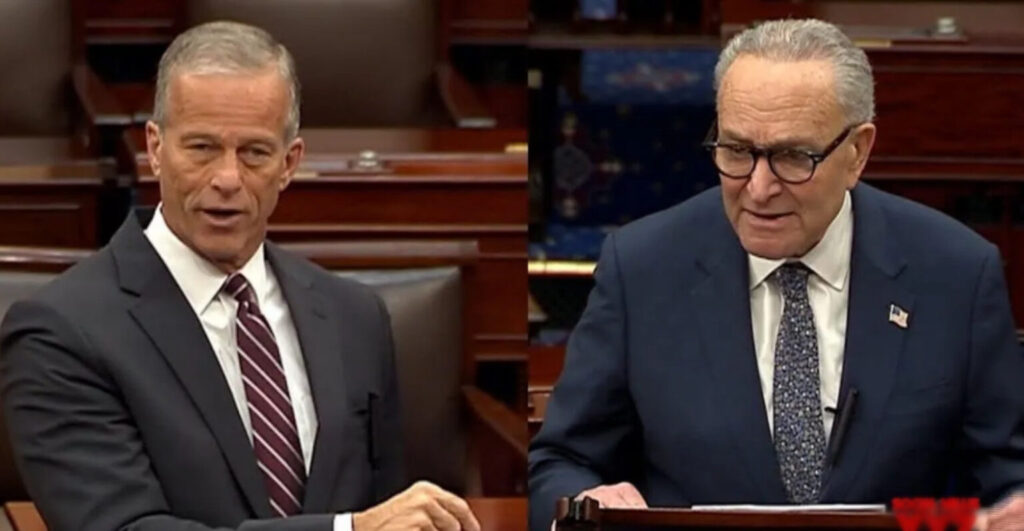
Senate Majority Leader John Thune said Monday that the Safeguard American Voter Eligibility Act, known as the SAVE Act, will receive a floor vote in the coming weeks, marking a major step in Republicans’ push to establish proof-of-citizenship requirements for federal elections.
The bill, which passed the House in April, would require individuals registering to vote in federal elections to provide documentary proof of U.S. citizenship. Acceptable forms include a passport, birth certificate, naturalization certificate or other government-issued documents verifying citizenship.
The measure also directs states to use federal databases, including those from the Social Security Administration and the Department of Homeland Security, to verify the citizenship status of registered voters. It requires states to remove non-citizens from voter rolls if identified and imposes penalties on election officials who knowingly process voter registration applications without proper documentation.
Thune confirmed that the Senate will move the bill to the floor after additional technical changes are made, including language that clarifies acceptable forms of identification. He said the chamber would vote “at some point soon” but did not provide a specific date.
The SAVE Act cleared the House on April 10 by a vote of 220-208. Four Democrats—Reps. Jared Golden of Maine, Ed Case of Hawaii, Marie Gluesenkamp Perez of Washington and Henry Cuellar of Texas—joined Republicans in supporting the legislation.
The bill faces a steep path in the Senate, where Democrats hold a narrow majority. It would need 60 votes to overcome a filibuster and advance to final passage. Even so, Senate Republicans have pressed for the vote to place Democrats on record ahead of the 2026 midterm elections.
The legislation has also been at the center of an internal standoff between House and Senate Republicans. In December, Rep. Anna Paulina Luna of Florida led a coalition of House conservatives who pledged to block unrelated bills from advancing to the Senate until the SAVE Act received a vote. Luna and others have described the measure as a test of Congress’s commitment to election security.
The SAVE Act is designed to create a uniform federal standard for verifying voter eligibility. Under current law, individuals registering to vote for federal elections are required to attest, under penalty of perjury, that they are U.S. citizens, but they are not required to present documentation. Supporters of the bill argue that this system leaves states vulnerable to administrative errors and, in rare cases, non-citizen registrations.
Opponents say the legislation is unnecessary and could lead to the disenfranchisement of eligible voters who may have difficulty obtaining the required documents. Civil rights organizations have warned that stricter requirements could disproportionately affect elderly, low-income and rural voters, as well as those born outside traditional hospital systems who may lack official birth certificates.
Democrats have largely dismissed the bill as redundant, citing a lack of evidence that non-citizen voting is a widespread problem. The Brennan Center for Justice, a nonpartisan policy institute that tracks election integrity issues, found that cases of non-citizen voting account for “a fraction of a fraction of a percent” of total ballots cast nationwide.
Republicans counter that the absence of strong verification requirements undermines public confidence in elections, pointing to polling that shows broad public support for voter ID laws. A recent survey by Quantus Insights found that 74 percent of respondents supported requiring proof of citizenship to vote, while only 16 percent opposed such measures.
The Trump administration has made election security a top priority, and President Donald Trump has repeatedly endorsed the SAVE Act, saying it would strengthen faith in the democratic process and ensure that only citizens are voting in federal elections.
Democratic leaders, including Senate Majority Leader Chuck Schumer and Sen. Raphael Warnock of Georgia, have said they will oppose the measure, calling it a solution in search of a problem. Schumer said the Senate will continue to focus on expanding access to the ballot rather than imposing new restrictions.
Even if the bill fails in the Senate, Republicans say they plan to continue pushing for voter ID and citizenship verification laws at the state level. Similar measures are already under consideration in several Republican-led legislatures, including Texas, Florida, and Arizona.