The Folder
My lawyer’s name is Robert Chen, and he has been my lawyer for twenty-two years.
The morning after my granddaughter Rachel’s wedding, I called him and told him what had happened.
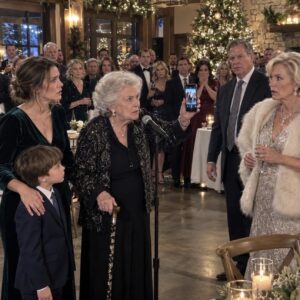
I was seventy-three years old. Rachel was twenty-six. I had paid nearly sixty thousand dollars toward her wedding—the hotel, flowers, musicians, photographer, and other expenses. Yet when I arrived at the venue in my pale pink dress, my son Gerald stopped me at the entrance.
My name wasn’t on the guest list.
I had simply said, “It’s okay, son,” and gone home.
Now the folder containing every receipt, invoice, contract, bank transfer, and email sat open on my desk.
Robert listened carefully.
“How much did you pay?” he asked.
“Forty-seven thousand, three hundred dollars directly,” I said. “And another twelve thousand transferred to Gerald.”
“Do you have documentation?”
“I have everything.”
“Of course you do,” he said.
I have always kept records. My late husband James used to say that paperwork was how you respected the arrangements you made.
Robert asked what I wanted.
“I want Gerald to understand what he did,” I said. “On record. In a way he cannot dismiss.”
The next morning, Robert sent Gerald and Catherine a formal demand for reimbursement of the $59,300.
He also sent Rachel a letter explaining what had happened, without asking her to take sides.
Finally, he documented the incident in the family trust records. Rachel was entitled to a $40,000 trust distribution upon her marriage, and Robert made clear that her inheritance had nothing to do with the dispute.
Gerald began calling.
I didn’t answer.
Catherine eventually called and claimed there had been a “mix-up.”
“It wasn’t a mix-up,” I said. “Who decided my name would not be on the list?”
She had no answer.
Two days later, Rachel called.
“Grandma, I’m so sorry.”
She told me she had not known I had been excluded. She had also believed her parents had paid for the wedding.
“I paid for the hotel, flowers, musicians, and photographer,” I told her.
There was silence.
“Dad told me they were paying for the wedding,” she said.
“I know.”
“Are you going to sue them?”
“I’m going to pursue the legal options available to me.”
She asked if there was anything she could do.
“Be well,” I said. “You married a good man. Concentrate on your marriage.”
She cried.
“I’m sorry you weren’t there,” she said.
“So am I,” I answered.
Months passed.
Gerald’s lawyer argued that my payments had been gifts. Robert disagreed. He argued that the documentation, the planning, the invoices, and Gerald’s own email confirming the purpose of the $12,000 transfer showed that these were contributions toward the wedding, not unconditional gifts.
The judge allowed the case to proceed.
Eventually, Gerald’s attorney offered a settlement.
Robert asked if I wanted to accept it.
“No,” I said. “File the suit.”
The case went to mediation in November.
For the first time since the wedding, I sat across from Gerald.
He barely looked at me.
The mediator asked him what happened.
“I made a mistake,” he said.
I looked at him.
“Was my name deliberately removed, or was it never put on the list?”
He was silent.
Then he admitted it.
“It wasn’t put on.”
“Why?”
He finally said:
“Catherine’s family was sitting at the front. The arrangements were complicated. It was easier to have fewer people to worry about.”
Fewer people to worry about.
That was the sentence I remembered.
I had been the woman who paid for the wedding, yet somehow I had become an inconvenience to be managed.
Gerald eventually agreed to reimburse everything: $59,300, plus sixty percent of my legal fees.
I also insisted on a written acknowledgment that I had been excluded and that my payments were not gifts.
I did not ask for an apology.
An apology given under legal pressure would have meant nothing to me.
When it was over, I put the documents back into the folder.
I did not feel victorious.
I felt finished.
The money was returned, but the fact remained: my own son had accepted my money and then kept me outside the door.
At Christmas, Rachel and her husband Daniel came to my house.
She asked how I felt.
“Resolved,” I said. “Not healed.”
Later, she told me she had confronted her father.
He admitted he had not wanted me at the wedding because he felt judged whenever I was around.
I had never intended to judge him.
I had intended to keep things clear.
Rachel said she still loved her parents but was angry with them.
“Both things can be true,” I told her.
Before she left, I gave her the letter confirming her $40,000 trust distribution.
“It’s yours,” I said. “Your grandfather intended this for an important moment in your life. This has nothing to do with what happened between your father and me.”
She hugged me.
“I love you, Grandma.”
“I love you too.”
Then, in March, Rachel called again.
She was pregnant.
“I wanted you to be the first to know,” she said.
I sat in my study after the call and opened my notebook.
I wrote:
Rachel is pregnant. October.
Then:
I am going to be there.
Not a hope.
A fact.
I am Eleanor Whitmore.
I am seventy-three years old.
I keep records.
I print things.
I call my lawyer.
And I have learned something important.
The occasion is not always the thing itself.
The wedding belonged to Rachel.
The relationship between Rachel and me was something different.
Gerald could keep me out of a room.
He could not take that relationship away from me.
My husband James once told me that paperwork was how you respected the arrangements you made.
I finally understood something else.
The record tells you what happened.
But the people you love determine what happens next.
The folder is in the cabinet.
The dress is hanging on the door.
October is coming.
I am going to be there.
In the room.
That is enough.
Always enough.